Ten, fourteen and eighteen are the numbers that matter
Ten karat is the lowest purity that can legally be sold as gold in the United States, according to Money Metals. That makes 10K the floor of the market, and it holds only 41.7 percent gold. Meltvalue.com adds that 14K is 58.3 percent gold and carries a 585 stamp, while 10K carries 417.
Anyone ready to sell gold in Houston should notice how large the jump between grades is. At the October 9 close of $4,194.40 an ounce, a gram of pure gold holds $134.85 of metal, so a gram of 10K holds about $56 and a gram of 14K about $79. Two rings of equal weight can differ by more than $20 a gram in melt value, and the stamp is the only thing that tells them apart.
Reject any piece you cannot identify until it is tested
Not every piece carries a legible mark. Worn stamps, tiny clasps and old repairs leave gaps, and a buyer who guesses high on those pieces will correct the price downward later. Fineness marks such as .585 and .750 are the other way jewelers write 14K and 18K, so look for numbers as well as letters.
I'd set unmarked items in a separate pile and ask the buyer to test them in front of you. Do not file the metal or scrub the stamp to read it. If you plan to sell gold in Houston the same day, a test beats a guess, and a record of the test result is something you can compare with the next buyer's.
Weigh in grams, then convert to pennyweights
Home scales read grams, and buyers often quote in pennyweights. The National Institute of Standards and Technology lists the pennyweight at 1.5552 grams, with 20 of them in a troy ounce. NIST's own example turns 4.40 grams of jewelry into 6.84 pennyweights.
The conversion lets you check a quote. At $4,194.40 an ounce, one pennyweight of pure gold is $209.72, because you divide the ounce price by 20. A 14K ring weighing 5 pennyweights then holds about $612 of melt value, and a buyer who offers $300 is paying roughly half. Grams give the same answer, though the pennyweight shows how the trade talks.
Rank solid gold above plated and filled pieces
Metalcharts.org makes a blunt point about plated jewelry. The gold layer adds almost nothing, and most scrap buyers will not pay for it. A chain that looks bright but carries no karat stamp may belong in the plated pile.
Retail prices mislead people here. Estimonia says jewelry typically sells at two to five times its melt value, so the receipt in your drawer overstates what the metal will fetch. The melt formula works when the item is solid karat gold. It breaks when the piece is plated, set with stones or valued for its design, and a buyer will price those by other rules.
The common mistake is counting the receipt price as the gold value. The cost is a bad surprise at the counter and a quick, wrong suspicion that the buyer is cheating you. Sort first, then calculate.
Check your scale against the buyer's
Some kitchen scales round to the nearest whole gram, and that hides real money on small pieces. At about $79 a gram of 14K, a one-gram error is worth $79, which is more than many buyers lose in a day on a modest purchase. I'd weigh each pile twice, note both readings and request a look at the display for each lot.
Group the pieces by karat before weighing, because each karat gets its own multiplier. A single mixed total is useless for checking an offer, since the buyer has to guess the blend. If you sell gold in Houston with pieces already sorted, the counter conversation takes minutes and leaves little room for a vague average.
Weigh and tally before you leave the house
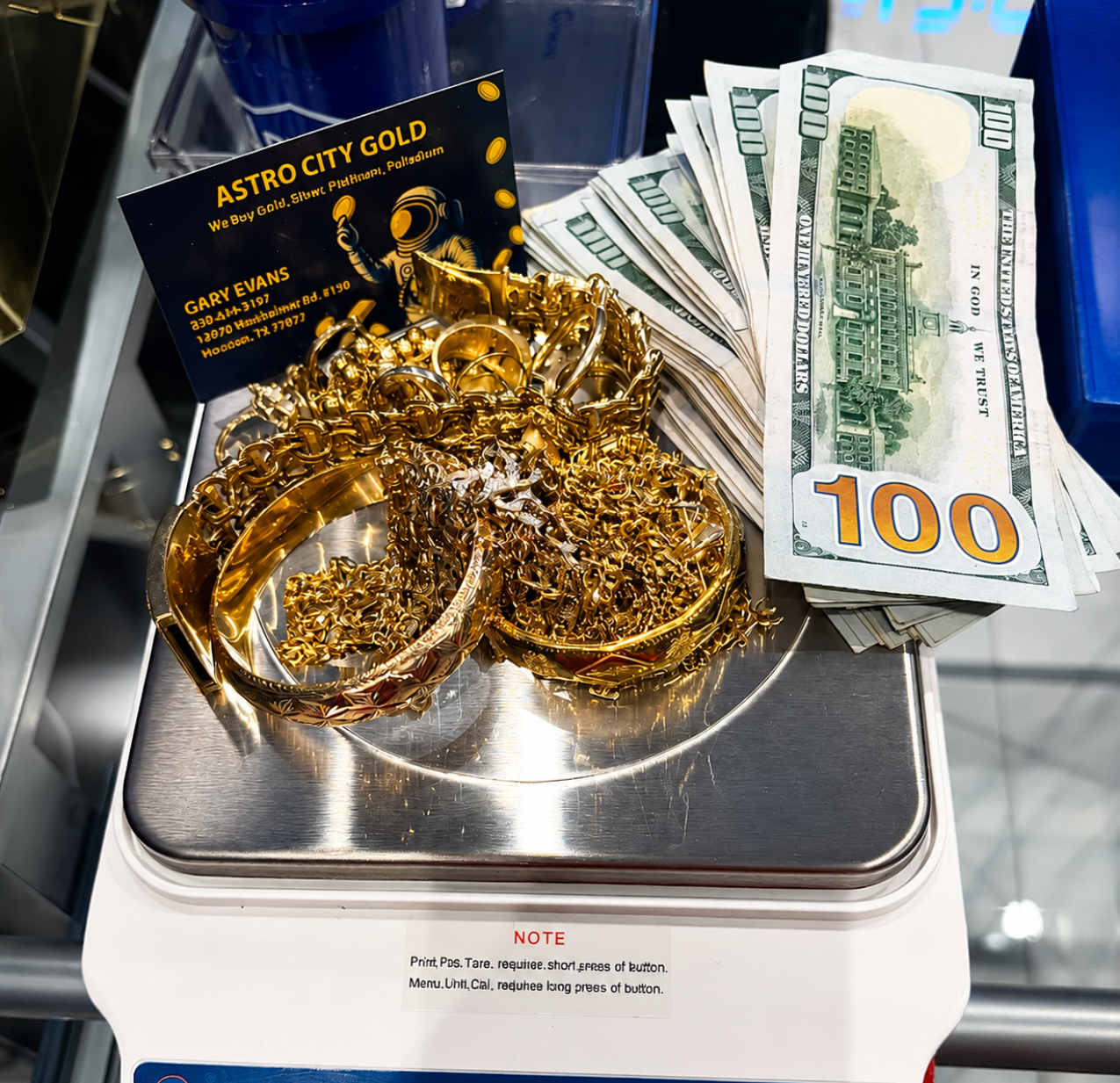
Make three piles on a clean table. Put stamped 10K, 14K and 18K pieces in the first pile, unmarked pieces in the second and anything plated in the third. Weigh each of the first two piles in grams, write the totals on paper and photograph the stamps before you sell gold in Houston or anywhere else. astro city gold, open daily from 7 AM to 9 PM at 12970 Westheimer Rd #150, says it weighs pieces in front of you. Match its readings against your own totals.
Frequently Asked Questions
Q: What does a 750 stamp mean?
A: It marks 18K gold, which is 75 percent pure. The Right Trader's calculator lists .585, .750 and .999 as the fineness marks for 14K, 18K and 24K. A stamp written as a number is just the karat expressed as parts per thousand.
Q: Why do buyers weigh in troy ounces and not regular ounces?
A: Gold is priced in troy ounces, which weigh 31.103 grams against 28.35 for a standard ounce. That makes the troy ounce about 10 percent heavier. Mixing the two in a hand calculation can cost you real money.
Q: How much does a typical gold ring or chain weigh?
A: Money Metals says a men's 14K wedding band usually runs 6 to 10 grams, and a substantial chain can run 20 to 40 grams. Priced near $79 a gram for 14K, that is roughly $470 to $790 for the band and $1,570 and up for a 20-gram chain. Weigh yours instead of estimating.
Q: Why do jewelers count in grains?
A: Troy weight is built from grains, and 24 grains make one pennyweight, according to Stuller. A gram is about 15.43 grains. You rarely need grains, but they explain why bench scales and scrap tickets use unusual units.